Wi-Fi CO₂ & Air Quality Monitor · USB Edition

See how indoor air changes — hour by hour.

Built around dual Swiss Sensirion sensors (photoacoustic NDIR CO₂ + VOC index), with a 7-day web history dashboard, instant Telegram alerts, and 100% local Home Assistant integration. No cloud account, no mandatory app, and open APIs ready for makers.

  • 1-hour, 24-hour, and 7-day history built in: stored in onboard flash so you can spot overnight or afternoon CO₂ spikes, surviving reboots and updates.
  • True NDIR CO₂ + dedicated VOC odor & gas sensing: catches everyday air events CO₂-only meters miss — cooking fumes, cleaners, cat litter / pet odors, off-gassing, and sudden room odors; fanless, silent, and smaller than a credit card.
  • Local-first, ready out of the box and open to integrate: Telegram alerts without a server, official Home Assistant HACS integration (with in-HA OTA), MQTT, REST API, and Prometheus.

The full illustrated setup, calibration, Telegram, and Home Assistant guide is public — see exactly how it works beforehand.

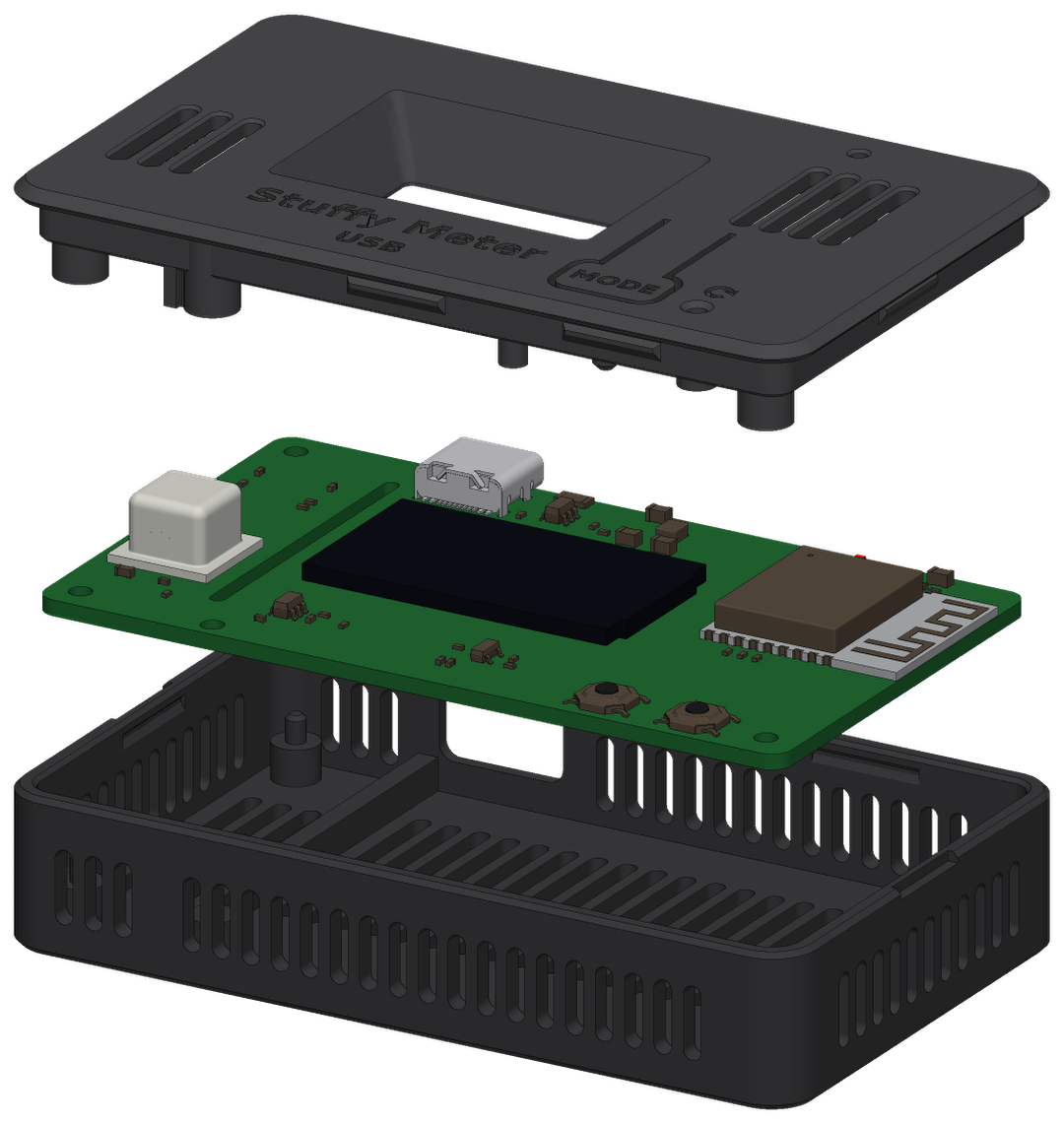
Stuffy Meter 3D exploded CAD view showing isolated sensors, ESP32-C3 PCBA, 1.14-inch display, and snap-fit enclosure
Sensirion SCD41 NDIR Sensirion SGP40 VOC 81 × 49 × 16.6 mm Fanless · Silent
True NDIR CO₂
±(50 ppm + 2.5%)

Sensirion SCD41 measures real CO₂ molecules without alcohol or perfume false spikes, with ASC, manual FRC, and altitude compensation.

Dedicated VOC Odor & Gas Index
1 – 500

Sensirion SGP40 samples every second — catching cooking fumes, cleaners, cat litter odors, furniture off-gassing, and even sudden farts.

7-Day Onboard History
1h · 24h · 7d

1-minute resolution for the last 24 h plus 15-minute rollups for 7+ days in onboard flash — preserved across power loss and updates.

Compact & Silent
81 × 49 mm

Smaller than a credit card (16.6 mm thin), completely silent fanless design with no laser dust module to clog or wear out.

Everyday Indoor Air

Why seeing your indoor air actually changes your day

Sealed air-conditioned bedrooms, long WFH afternoons, cooking fumes, and humid summers all leave clear signatures you can spot and fix in minutes.

AC Bedroom · Sleep Quality

Slept 8 hours and still woke up groggy?

In a closed air-conditioned bedroom, two people easily push CO₂ past 1,500–2,000 ppm within 3 hours. Scheduled night-mode keeps the screen dark while you sleep, and the 7-day chart reveals exactly when stuffiness builds up.

WFH · Study Focus

3 PM brain fog isn’t always lunch

Closed home offices regularly cross 1,200 ppm CO₂ during afternoon calls. Set a Telegram threshold alert so your phone nudges you to crack a window before drowsiness sets in.

Cooking · Pets & Litter · Cleaners & Odors

Tell stale CO₂ apart from cooking, cat litter, and everyday odors

Most CO₂ meters are completely blind to cooking fumes, cleaning sprays, new-furniture off-gassing, a cat digging in the litter box, or even a sudden fart across the room. A dedicated SGP40 VOC sensor tracks these changes every second — triggering a Telegram scoop reminder or boosting your air purifier automatically via Home Assistant.

Humidity · Mold & Nursery

Dew point mold awareness, zero fan noise

Live dew point and absolute humidity warn of condensation and mold risk better than relative humidity alone — and the fanless, silent design sits safely beside a crib or bed.

Why Stuffy Meter

Stuffy Meter vs. standalone meters & hub-dependent BLE smart monitors

Most branded Bluetooth CO₂ monitors only measure CO₂, temperature, and humidity (no VOC sensor), and require an extra Wi-Fi hub plus a cloud app for remote alerts. Stuffy Meter combines built-in Wi-Fi, dual Swiss Sensirion sensors (true NDIR CO₂ + dedicated VOC), and 100% local ownership.

Aspect Budget Standalone / eCO₂ Branded BLE Smart (Hub Required) Stuffy Meter (Built-in Wi-Fi · NDIR + VOC)
Total Cost (Wi-Fi + Alerts) No Wi-Fi, no phone alerts Monitor (~$70 USD) + required Wi-Fi Hub (~$40–70 USD) = ~$110–140 USD Built-in Wi-Fi, $0 hub needed — web dashboard & Telegram alerts right out of the box
CO₂ measurement Gas-resistance eCO₂ estimate, skewed by alcohol or cleaners NDIR CO₂ sensor Swiss Sensirion SCD41 photoacoustic NDIR, typical accuracy ±(50 ppm + 2.5%)
Dedicated VOC Sensor & Dew Point Often conflated with eCO₂ — cannot separate stuffy CO₂ from odors Typically CO₂ / T / RH only (no VOC sensor — blind to cooking, cleaners & pet odors) Key differentiator: dedicated Sensirion SGP40 (1–500 index) catching cooking fumes, cleaners, cat litter / pet odors, off-gassing & sudden odors + live dew point & absolute humidity
History & everyday access Live reading only, no history Requires proprietary app & cloud account sync 7 days in onboard flash (1h / 24h / 7d); press BOOT anytime for a Dashboard QR code any phone can scan
Privacy & smart home Closed standalone unit Cloud account focused; Home Assistant often needs extra BLE proxies 100% local LAN, zero cloud account; native Home Assistant HACS, MQTT, REST API & Prometheus / Grafana
Noise, enclosure & updates Fan hum & dust buildup; rarely updated Closed shell & vendor cloud lifecycle Fanless & completely silent; automatic nightly OTA with rollback; open 3D-printable STL files
Built-In Web Dashboard

Understand your daily and weekly indoor air patterns

No app to install and no cloud login. One-screen Wi-Fi setup auto-detects your language and time zone, and pressing BOOT shows a Dashboard QR code anytime so any phone opens live 1 h / 24 h / 7 d charts in one scan.

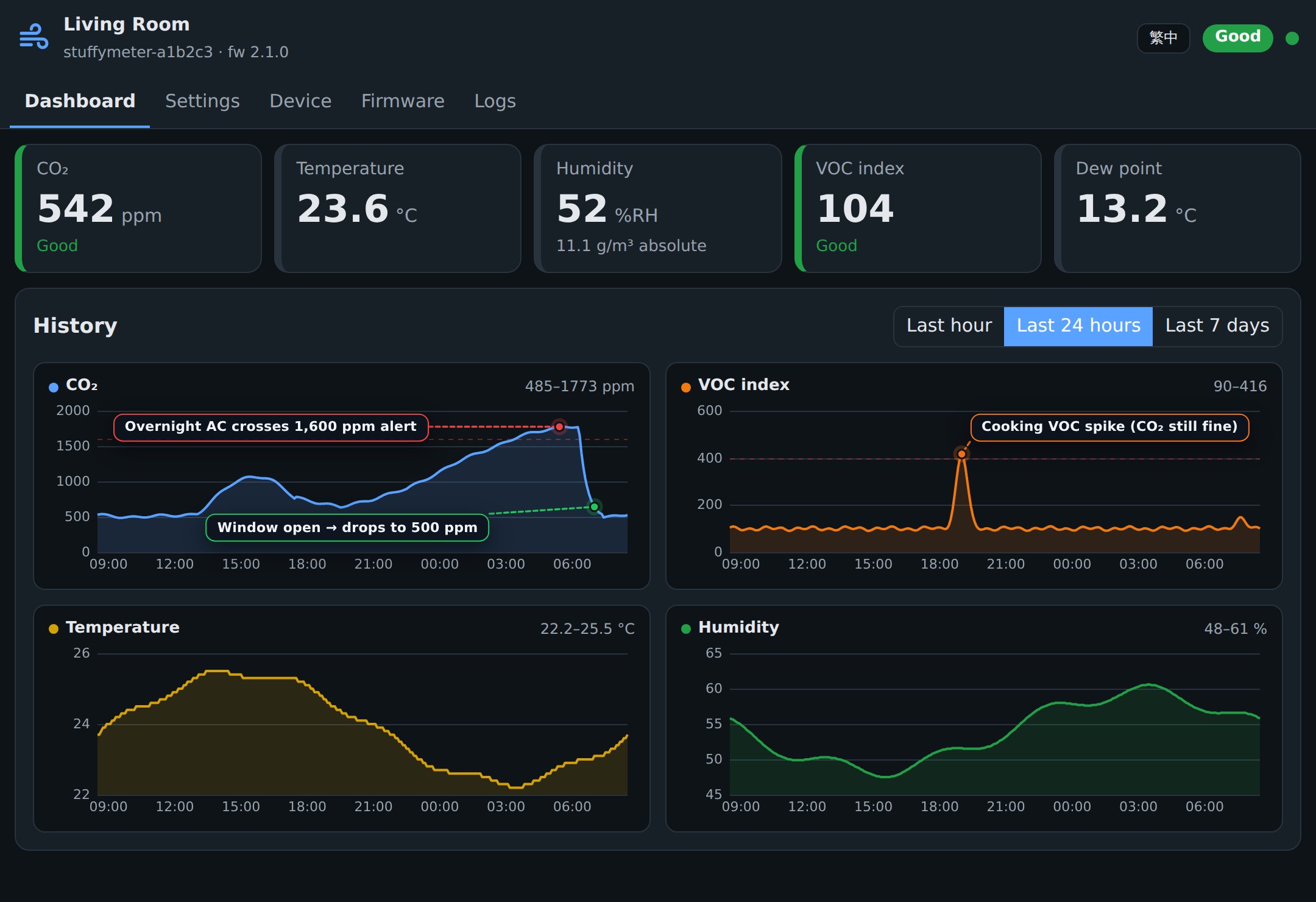
Stuffy Meter 24-hour web dashboard showing CO₂, VOC index, temperature, and humidity

Live KPI cards (including dew point and absolute humidity) paired with a synchronized 2×2 chart grid for CO₂, VOC index, temperature, and humidity.

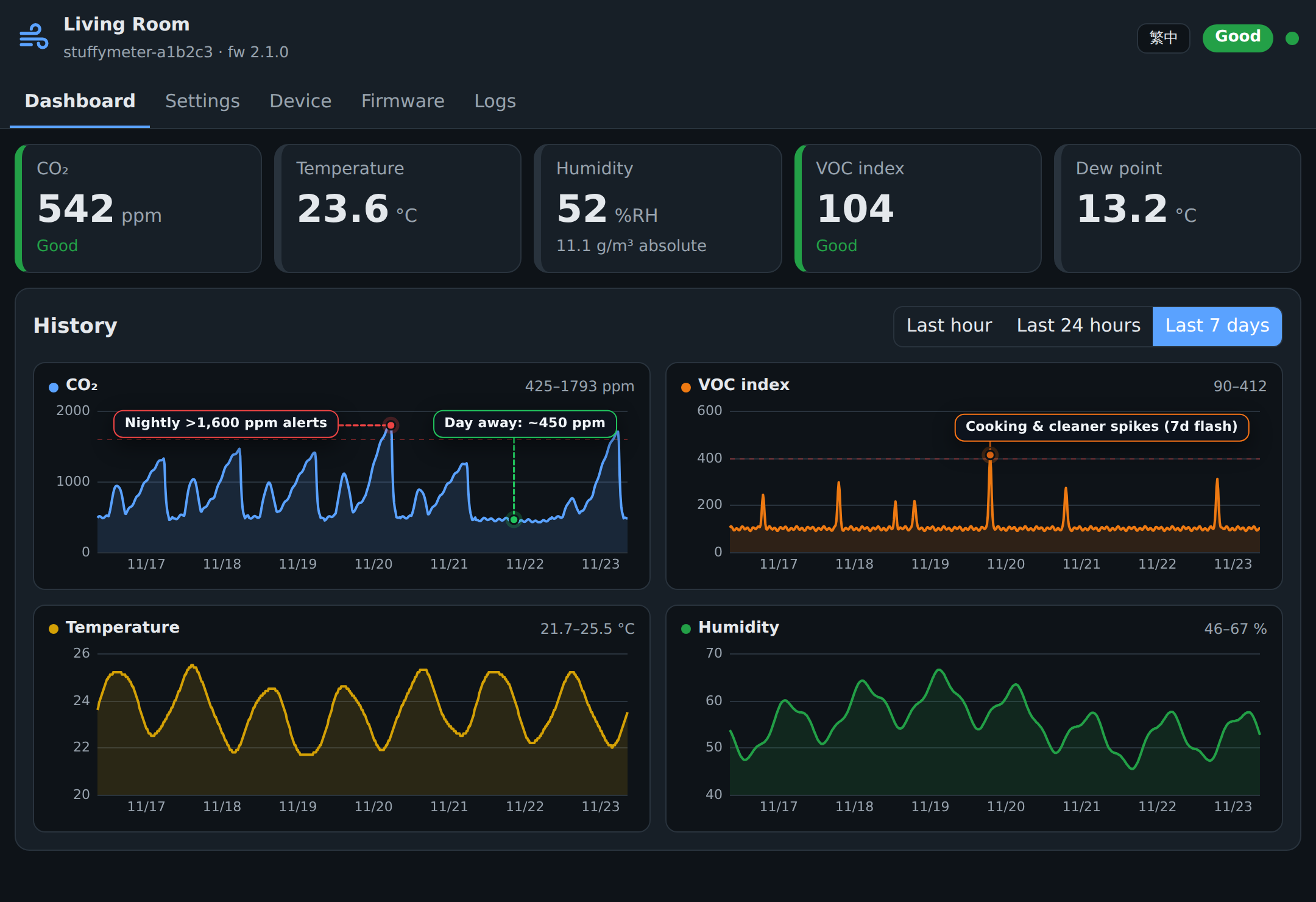
Stuffy Meter 7-day history trend view across all four sensors

Tiered flash storage keeps 1-minute resolution for 24 h and 15-minute rollups for 7+ days — making overnight CO₂ peaks and evening cooking VOC spikes easy to spot.

This is the real onboard web dashboard running live on simulated room data — switch 1h / 24h / 7d ranges, open Settings, or toggle English / Traditional Chinese.

Open Fullscreen Demo →
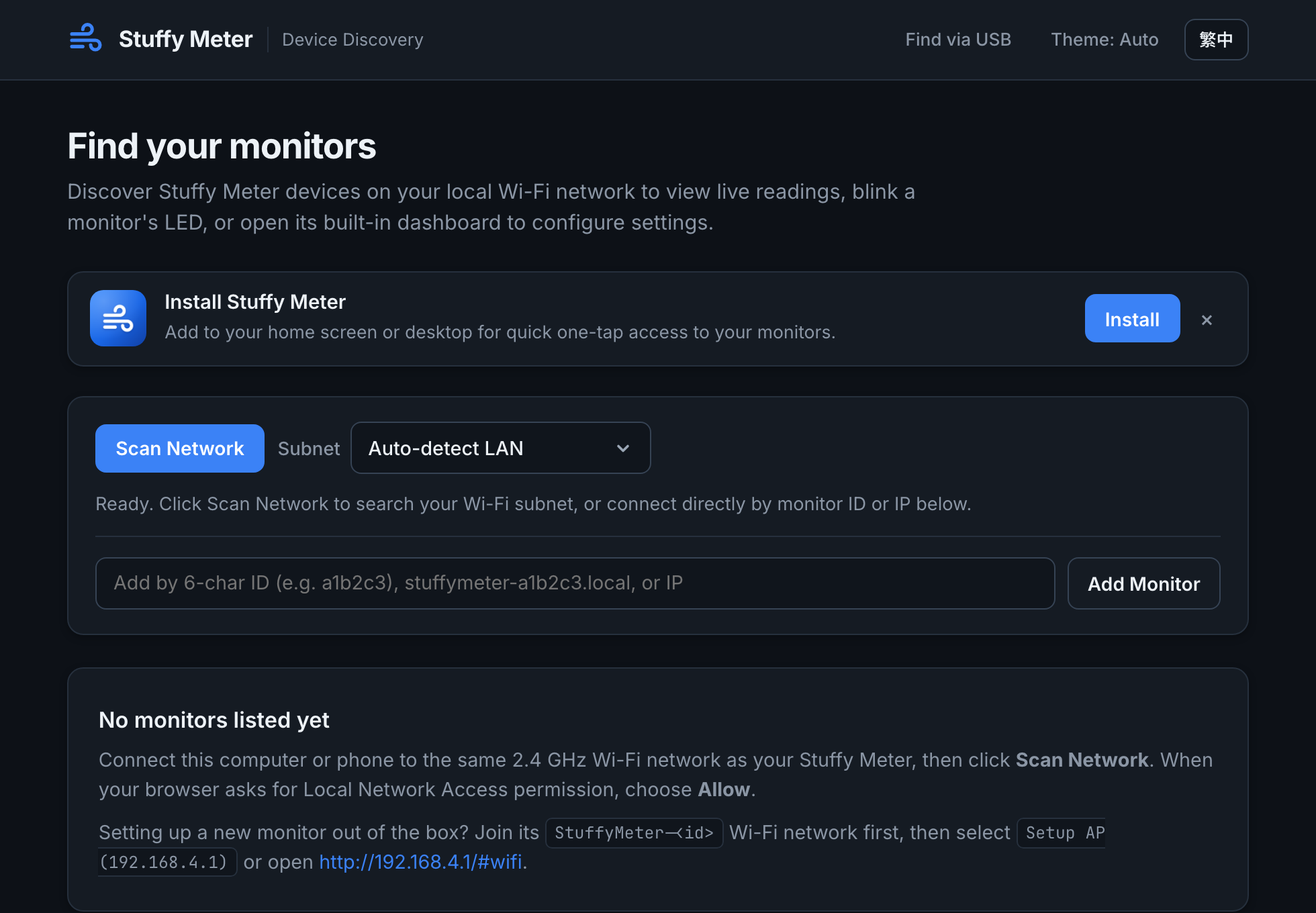
cmwang.dev/stuffy-meter browser-based local network device finder

Running multiple monitors? Open the built-in LAN Device Finder to scan your LAN right in the browser (no data leaves your network), blink a unit’s LED to locate it, or jump straight to its dashboard.

Sensing & Hardware Design

Smaller than a credit card, engineered around thermal isolation

At 81.0 × 49.0 × 16.6 mm (smaller than a standard 85.6 × 54.0 mm credit card), Stuffy Meter sits neatly under a display or on a nightstand — completely silent with no moving fan.

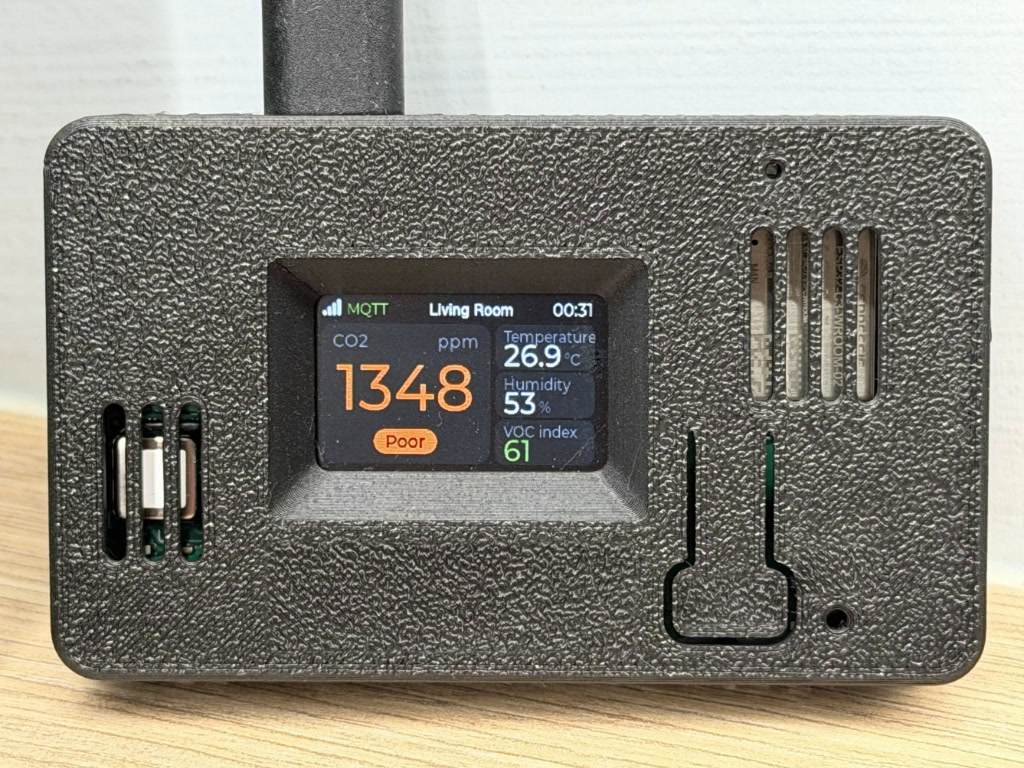
Stuffy Meter real hardware photo showing matte 3D-printed enclosure and 1.14-inch display with live readings

Real hardware: matte 3D-printed snap-fit enclosure, vented sensor chamber, status LED, and custom room name right in the status bar.

Sensirion SCD41 Photoacoustic NDIR

Samples every 5 seconds across 400–5,000 ppm (output up to 40,000 ppm), measuring CO₂, temperature, and relative humidity plus derived dew point and absolute humidity. Supports ASC, manual outdoor FRC, and altitude compensation.

Sensirion SGP40 Dedicated VOC & Odor Sensing

Samples every second with live climate compensation via Sensirion’s Gas Index Algorithm (1–500 relative index where 100 is your room’s 24 h baseline). Beyond paint and furniture off-gassing, it excels at everyday air events — cooking fumes, cleaners, perfume, a cat using or digging the litter box, and even sudden room odors or farts.

Isolated Sensor Chamber & Silent Fanless Build

A milled thermal slot in the PCB pairs with an internal enclosure baffle to keep Wi-Fi and power heat away from the sensors, with one-step reference thermometer calibration. Enclosure STL files are published openly if you want to print custom colors.

Stuffy Meter 1.14-inch IPS screen views: main dashboard, alert banner, Wi-Fi QR setup, and OTA update progress

1.14-inch color IPS TFT (240 × 135): displays your custom room name in the status bar, color-coded air-quality alerts, 24-hour on-device charts, Wi-Fi setup QR code, and scheduled night dimming.

What does the VOC index detect (and how does it differ from a formaldehyde-only meter)? The SGP40 is a broadband metal-oxide VOC relative-index sensor (1–500) that responds rapidly to everyday indoor gas and odor spikes — cooking fumes, cleaners and alcohol sprays, pet / cat litter box odors, farts and perfumes, as well as formaldehyde and solvents from new furniture. It is ideal for spotting odor events, verifying ventilation, and automating air purifiers, rather than measuring single-gas absolute formaldehyde concentration (ppm or mg/m³).
Alerts Without a Server

Connect Telegram and stay aware from anywhere

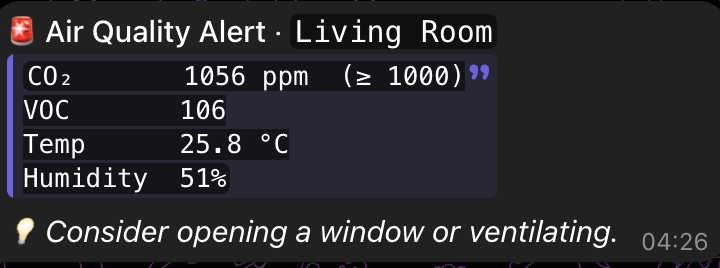
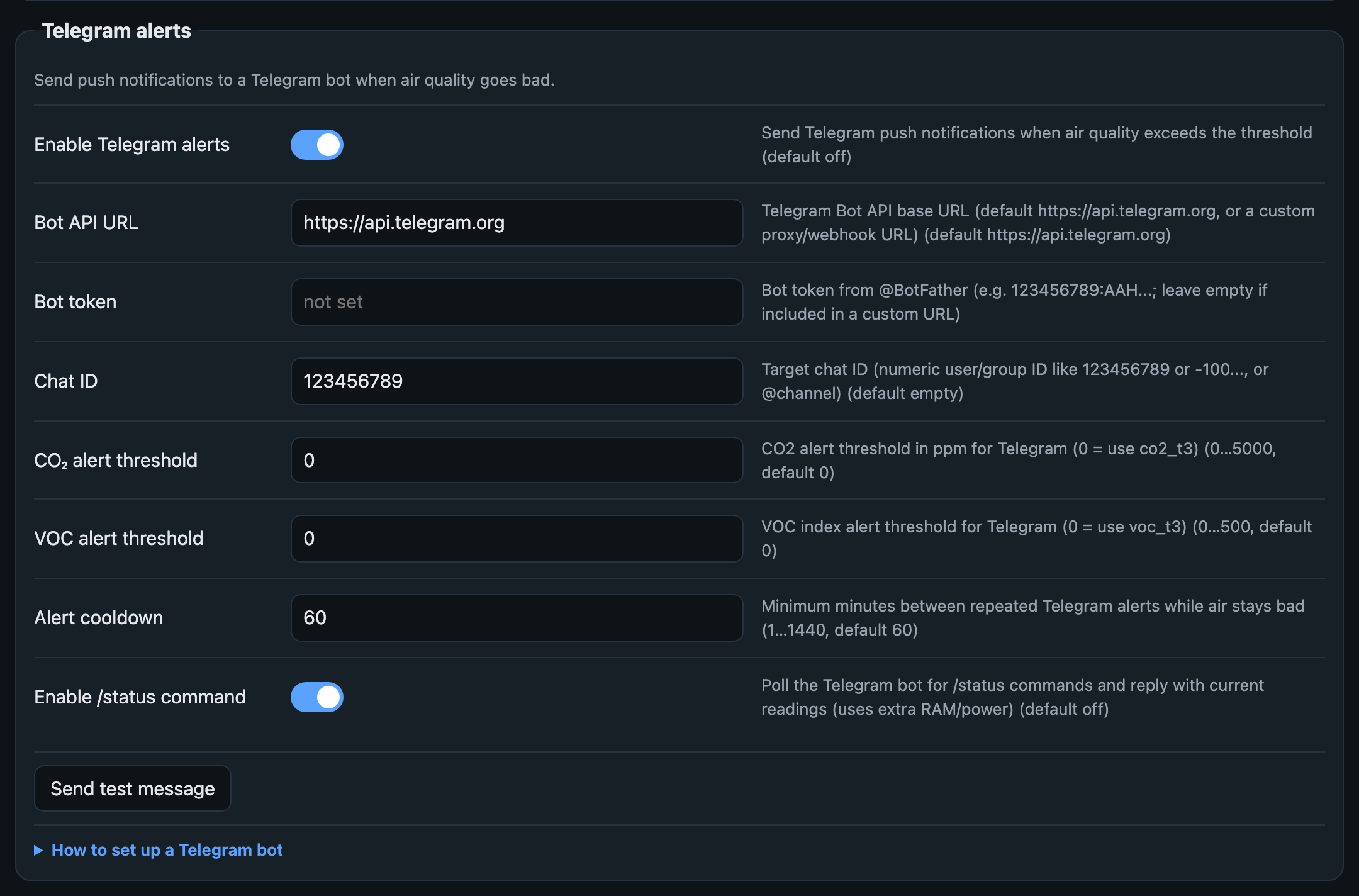
No server or smart-home hub required. Paste your Telegram Bot Token and Chat ID in Settings, and the monitor sends clean status cards straight to your phone whenever indoor air deteriorates.

  • Threshold alerts & recovery notices: get notified when CO₂ or VOC crosses your limits and again once air recovers, with hysteresis and cooldown to prevent spam.
  • Optional /status command: message your bot /status anytime to fetch live CO₂, VOC, temperature, and humidity on demand.
  • Room names in every message: headers display your friendly room name (e.g. Living Room) rather than a raw device ID.
Read Telegram Setup Guide
Example Telegram air-quality alert notification from Stuffy Meter
Stuffy Meter web Telegram alert settings card
Smart Home & Open Interfaces

Home Assistant, Grafana, and open APIs — 100% local

Whether you run Home Assistant automations, a homelab Grafana stack, or custom scripts, Stuffy Meter speaks standard local protocols with zero cloud dependency.

Official Home Assistant HACS Integration (No MQTT Needed)

Install ha-stuffy-meter and Home Assistant discovers every Stuffy Meter on your LAN automatically via mDNS (_stuffymeter._tcp) using the local REST API.

  • Zero-password sensors & Identify: CO₂, temperature, humidity, VOC index, dew point, absolute humidity, air-quality level, Wi-Fi RSSI, uptime, free heap, and LED Identify work without entering credentials.
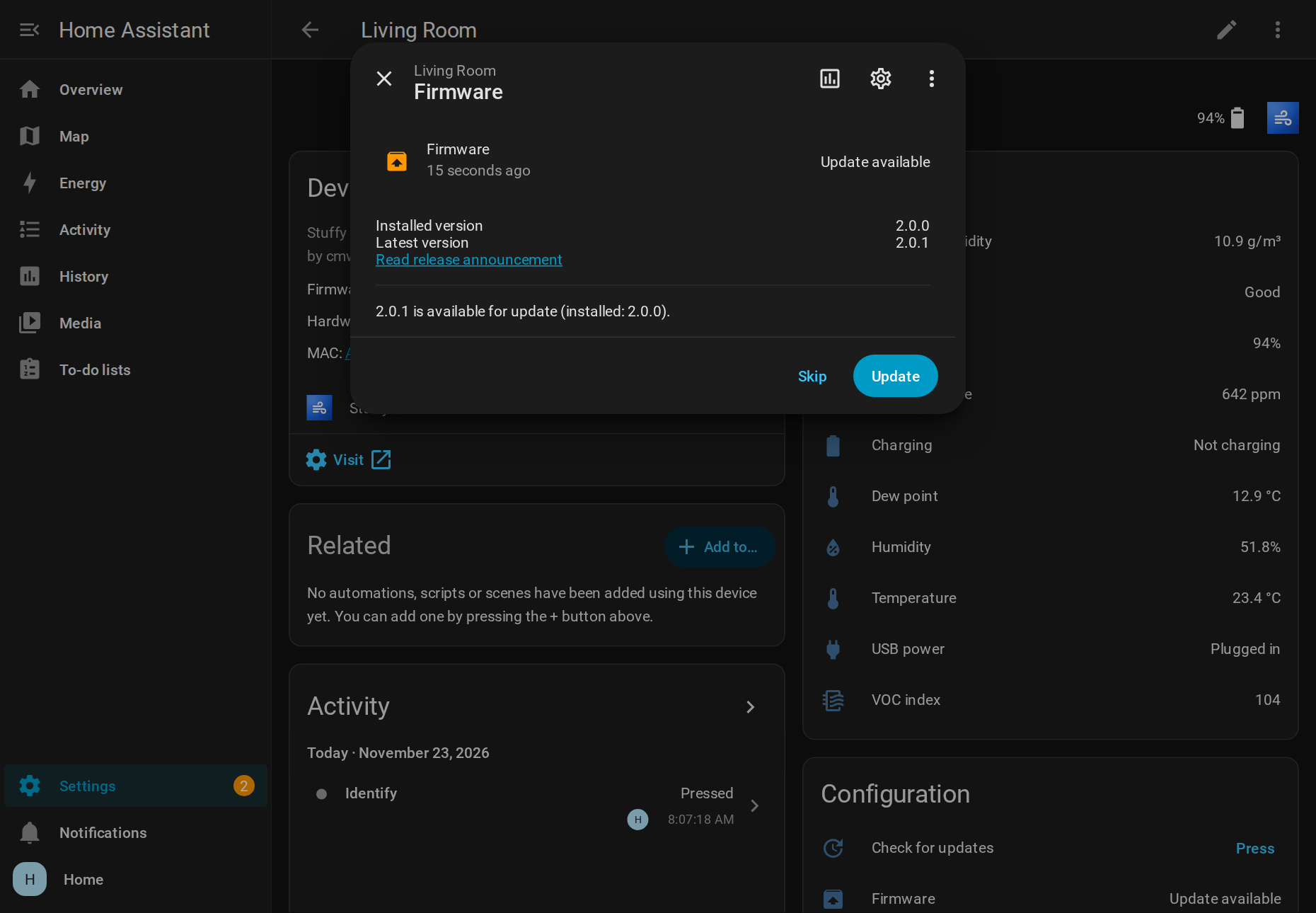
  • Native one-click OTA inside Home Assistant: new releases appear directly in HA Settings → Updates with release notes, live 0–100% progress, and one-click installation.

MQTT Auto-Discovery, REST API & Prometheus / Grafana

Prefer MQTT or Prometheus? Everything works locally out of the box:

  • MQTT Auto-Discovery: enter your broker URI in Settings (applied live, no reboot) to register all 11 entities automatically with synced room names.
  • Practical automations: turn on HRV/fresh-air fans above 1,000 ppm CO₂; boost an air purifier (or alert you to scoop the litter box) when cooking or pet VOC spikes hit; or trigger a dehumidifier from dew point and humidity.
  • REST API & Prometheus /metrics: query /api/status and /api/history, or deploy the standalone Docker Compose Grafana stack (5-year default retention) from GitHub Releases.
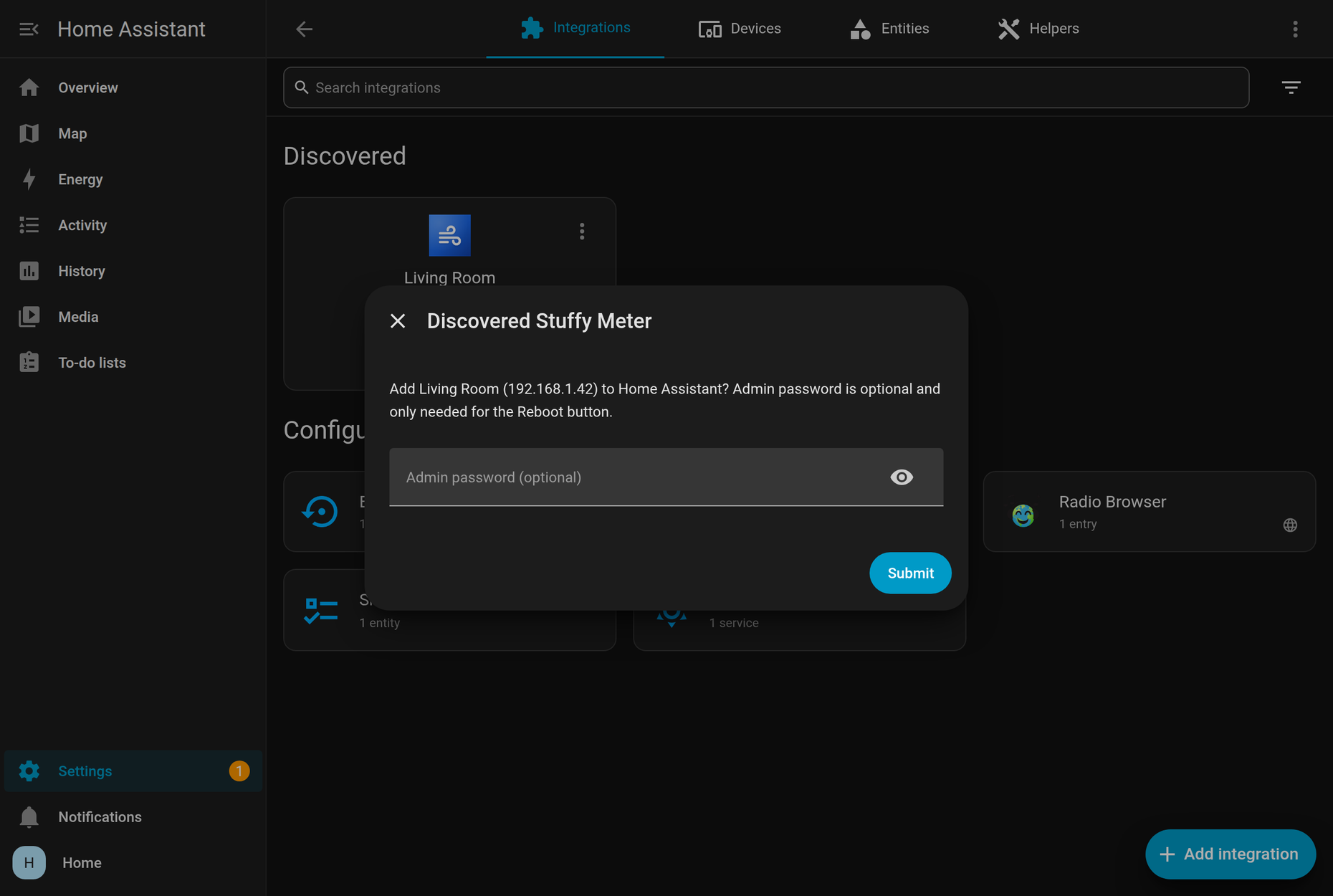
Home Assistant automatic mDNS discovery confirmation for Stuffy Meter

After installing via HACS, monitors on your LAN appear automatically under Settings → Devices & Services — click Add to connect locally without an MQTT broker.

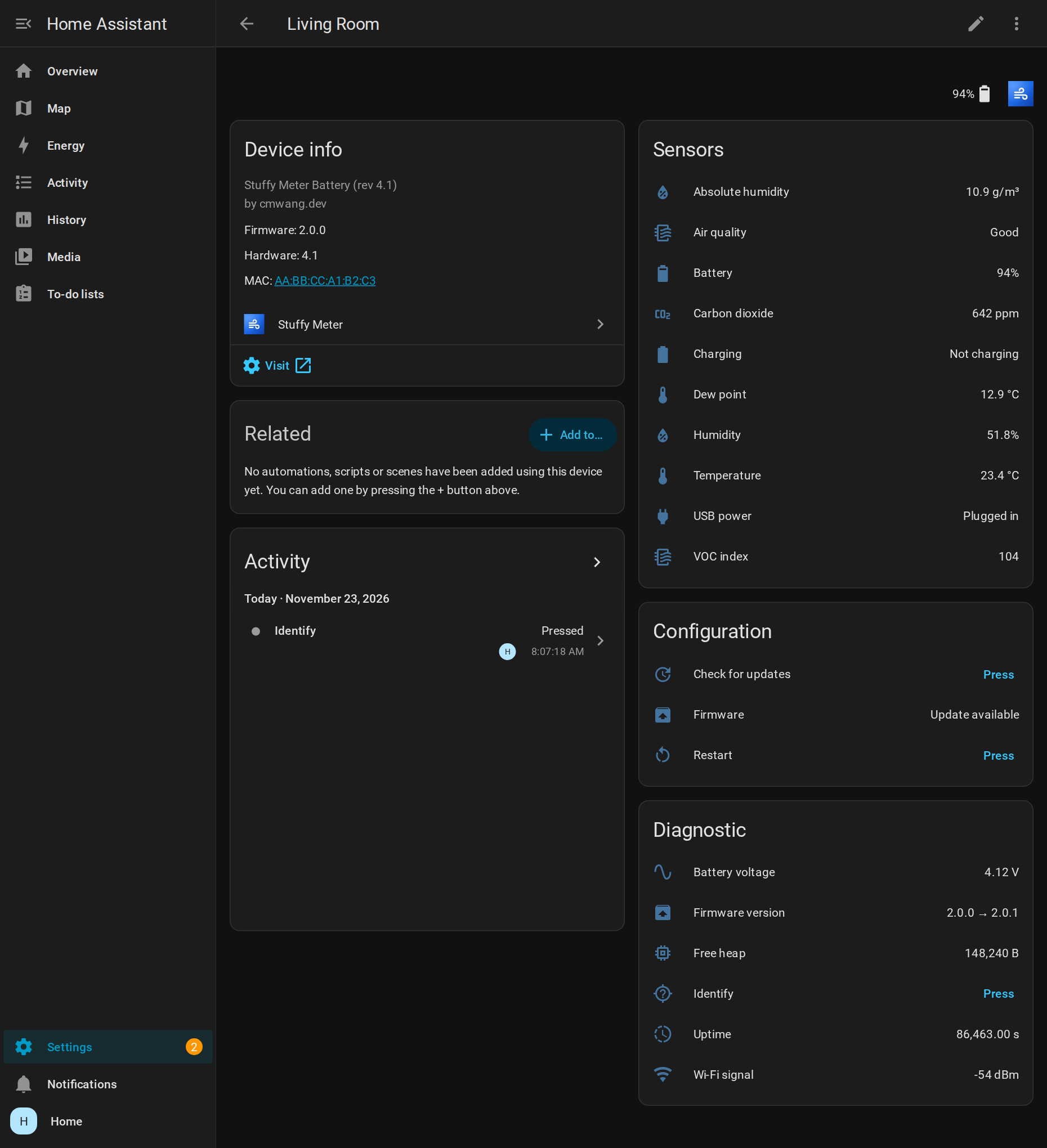
Stuffy Meter device page in Home Assistant showing sensors, diagnostics, and firmware status

The Home Assistant device page exposes all environmental sensors, diagnostics, LED Identify, Restart, and firmware update status (battery entities shown apply to the Battery edition; USB edition exposes climate, network, and update entities).

One-click OTA firmware update dialog for Stuffy Meter inside Home Assistant

Check release notes and run wireless OTA firmware updates directly from Home Assistant’s native Updates panel with live progress.

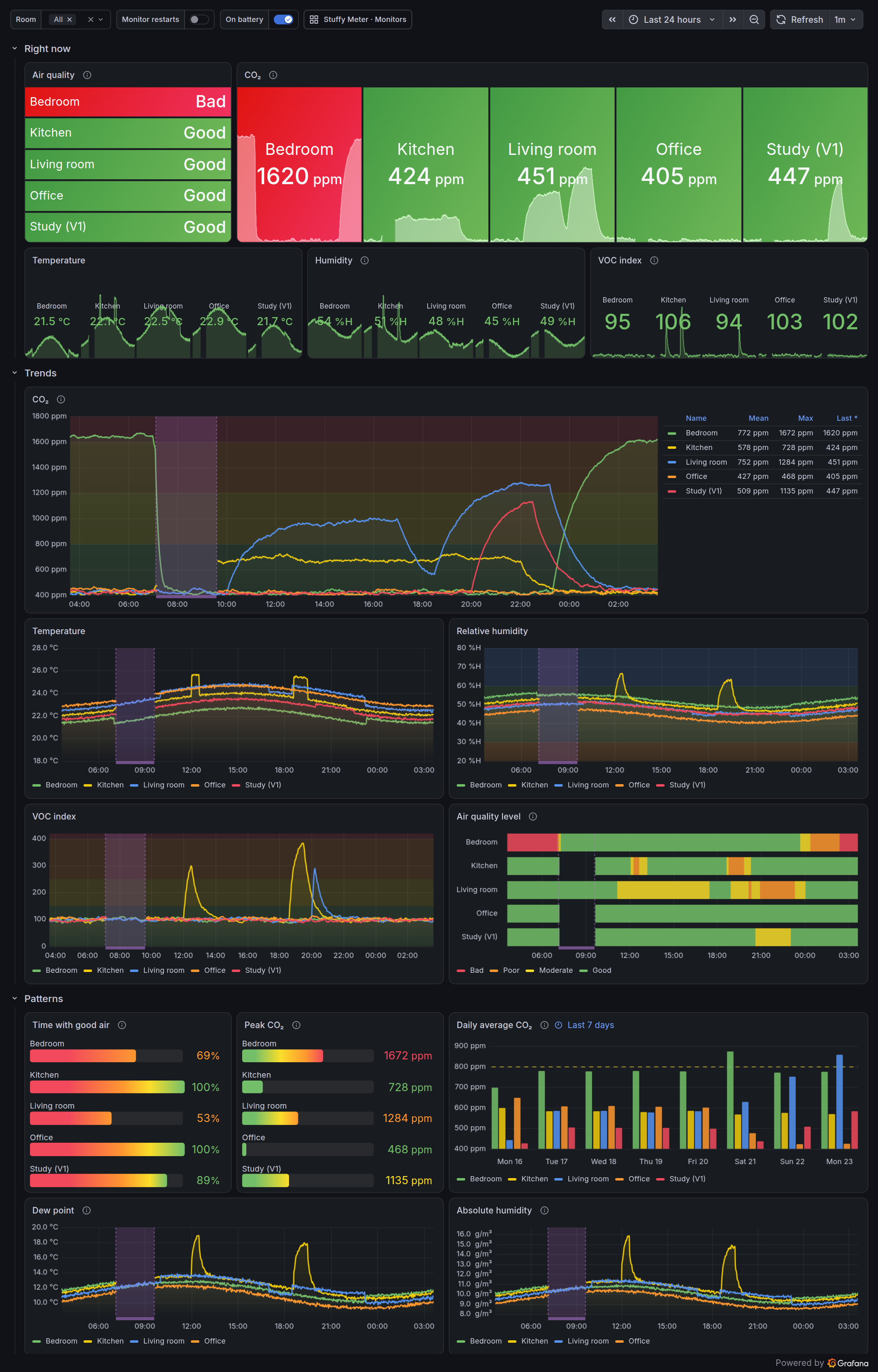
Grafana multi-room air quality dashboard fed by Prometheus

Public GitHub Releases include a standalone Docker Compose monitoring stack (Prometheus + pre-built Grafana dashboards + mDNS discovery, 5-year default retention). See the Prometheus & Grafana guide.

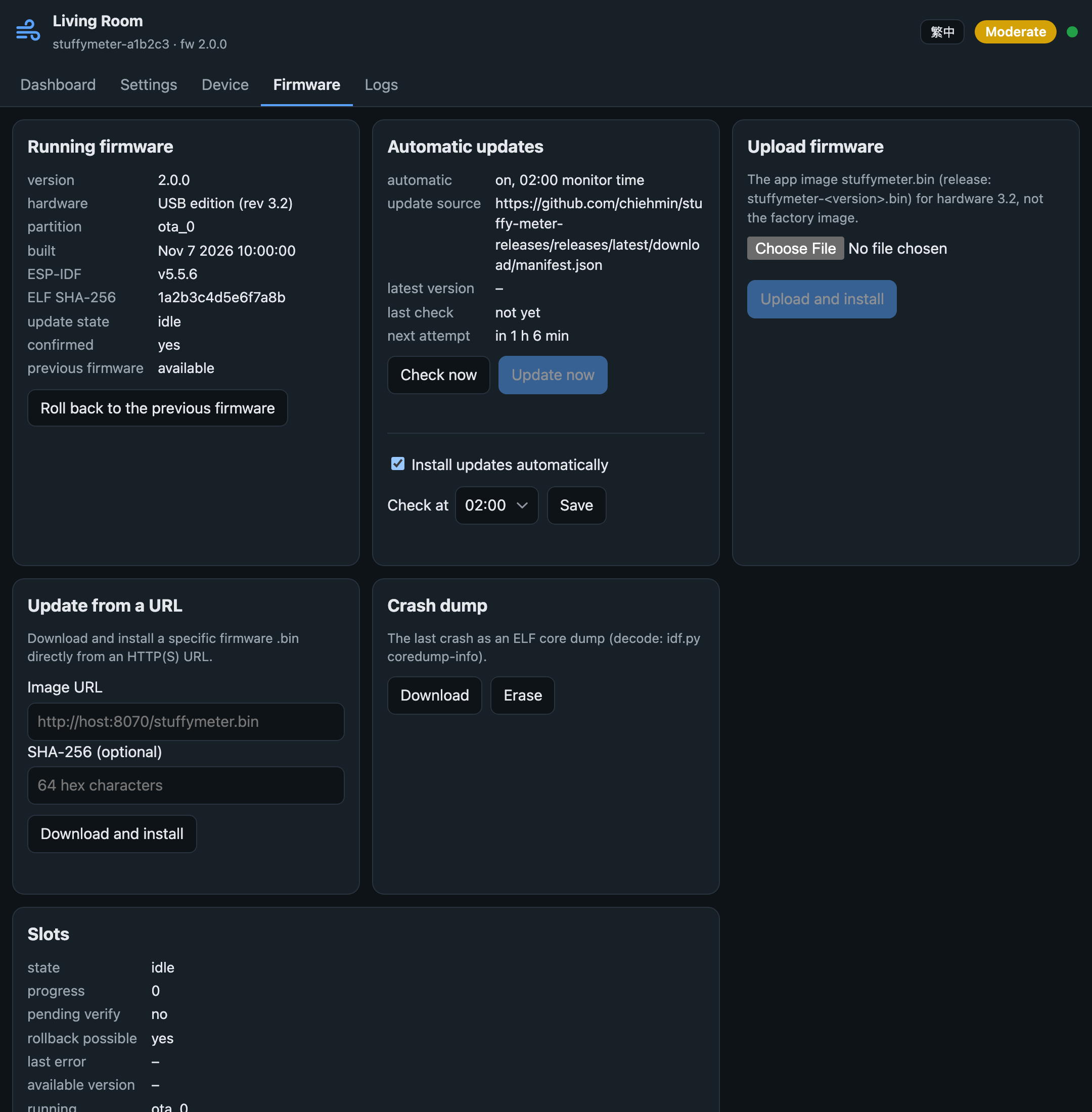
Stuffy Meter built-in Firmware page showing automatic nightly GitHub OTA and rollback

Monitors check GitHub Releases automatically overnight and install updates into a dual-slot partition with a 10-minute health probation and automatic rollback if anything goes wrong.

Engineering Story

From a breadboard experiment to Hardware as Code

Stuffy Meter isn’t a rebranded off-the-shelf unit — it was designed from scratch by a software engineer and documented openly on cmwang.dev.

01 · PROTOTYPE

Sensor validation

After testing budget eCO₂ sensors and seeing wide drift, the design moved to Sensirion’s SCD41 photoacoustic NDIR and SGP40 paired with Prometheus and Grafana.

02 · PCBA

From hand-soldered carrier to full SMT PCBA

Replaced dev-board stacks and hand wiring with a custom two-layer ESP32-C3 board assembled end-to-end via automated SMT.

03 · HARDWARE AS CODE

Hardware as Code & emulation

Schematics, layout checks, SPICE simulations, and 3D enclosures are generated and verified by scripts, while firmware recovery and OTA rollback are tested in ESP32-C3 QEMU.

04 · ECOSYSTEM

Field-tested local ecosystem

Refined across real rooms over months of daily use: 7-day flash history, PWA dashboard, Telegram alerts, official Home Assistant HACS integration, and complete public guides.

Specifications & Public Resources

Technical Specifications (USB Edition · Hardware rev 3.2)

Setup guides, API references, 3D enclosure STLs, and the Grafana monitoring stack are all public so you can inspect everything upfront.

Model / Edition Stuffy Meter USB Edition (hardware rev 3.2, ships with latest stable firmware)
MCU ESP32-C3-WROOM-02-N4 (32-bit RISC-V 160 MHz, 400 KB SRAM, 4 MB Flash)
CO₂ / Climate Sensor
Sensirion SCD41 (photoacoustic NDIR)
CO₂ specified range: 400–5,000 ppm (output up to 40,000 ppm)
Typical accuracy ±(50 ppm + 2.5%) @ 400–1,000 ppm; ±(50 ppm + 3%) @ 1,001–2,000 ppm; ±(40 ppm + 5%) @ 2,001–5,000 ppm
Temperature ±0.8 °C (15–35 °C, adjustable offset)
Humidity ±6 %RH (15–35 °C, 20–65 %RH)
VOC Sensor Sensirion SGP40 (metal oxide + Sensirion Gas Index Algorithm)
VOC index 1–500 (100 = 24 h room baseline), 1 s sampling with live SCD41 temperature/humidity compensation; responsive to cooking fumes, cleaners, pet / cat litter odors, everyday odors, and furniture/renovation off-gassing
Derived Metrics Dew point (°C / °F), absolute humidity (g/m³)
Onboard History 32 KB tiered flash ring: 1-minute resolution for 24 h + 15-minute rollups for 7+ days (survives reboots & OTA); 1 h / 24 h / 7 d web charts
Display 1.14” IPS TFT (240 × 135, ST7789V, 400 cd/m², PWM dimming, night mode), live room name in status bar
Wireless Wi-Fi 4 (802.11 b/g/n, 2.4 GHz only, WPA2/WPA3), mDNS (stuffymeter-xxxxxx.local, _stuffymeter._tcp)
IoT & Open APIs Built-in web dashboard (installable PWA), Telegram Bot alerts & /status command, Home Assistant (official HACS with in-HA OTA / MQTT Auto-Discovery), JSON REST API, Prometheus /metrics (standalone Docker stack available), native USB-C serial & full hardware pinout
Firmware & Updates ESP-IDF v5.5 + LVGL 9.5; automatic nightly GitHub Releases OTA, one-click Home Assistant updates, web upload, and dual-slot automatic rollback
Power & Protection USB-C 5 V (any 5 V / 1 A+ charger), ~50–100 mA (0.25–0.5 W) typical; 500 mA PTC resettable fuse & ESD protection (USB-C cable and adapter not included)
Size & Enclosure 81.0 × 49.0 × 16.6 mm (smaller than a credit card), fanless & silent; 3D-printed matte PLA snap-fit enclosure (~20 g), STL files published openly on Releases
Operating Range Indoor 0–40 °C non-condensing (best sensor accuracy 15–35 °C, 20–65 %RH; keep PLA enclosure out of direct sunlight and below 50 °C)
FAQ

Common questions before getting started

Is it easy to use without a home server or Home Assistant?

Yes — it works right out of the box. Scan the on-screen QR code to join Wi-Fi, open the web dashboard (or add it to your phone home screen) for 1 h / 24 h / 7 d charts, and optionally enter a Telegram bot token in Settings to receive alerts directly on your phone with zero servers. See the full Quickstart Guide.

Why does Stuffy Meter not measure PM2.5?

Laser PM2.5 modules require an internal fan, which adds bulk, creates audible hum on a nightstand, and suffers from fan wear and dust buildup over time — plus many homes already have an air purifier handling PM2.5. Leaving it out keeps Stuffy Meter completely silent, maintenance-free, and smaller than a credit card, focusing on true NDIR CO₂ and dedicated VOC odor & gas sensing.

What does the VOC sensor actually detect? Is it only useful for formaldehyde?

Not at all — it is genuinely useful every single day! The dedicated Sensirion SGP40 is a broadband metal-oxide VOC sensor that reacts quickly to all kinds of indoor gas and odor changes: cooking fumes, alcohol and cleaning sprays, perfumes, a cat using or digging the litter box, pet odors, even someone farting in a closed room, as well as formaldehyde and off-gassing from new furniture or paint. It outputs a 1–500 relative index (100 = your room’s 24 h baseline), making it ideal for spotting odor events and triggering air purifiers. Note that it reports an overall relative VOC index rather than single-gas absolute formaldehyde ppm/mg/m³, and takes roughly 12 hours after first power-on to learn the room baseline.

Does the 7-day history survive a reboot or power outage?

Yes. History is stored in a dedicated onboard flash partition (1-minute resolution for 24 hours plus 15-minute rollups for 7+ days), so unplugging power, rebooting, or installing an OTA update preserves your charts.

Can advanced users flash custom firmware like ESPHome?

The stock firmware already includes the web UI, 7-day history, Telegram alerts, and official Home Assistant HACS (with in-HA OTA) and MQTT integration. For heavy customizers, full hardware pinouts, native USB-C flashing, and bottom debug pads are available for custom integrations or third-party firmware such as ESPHome.

Does it support 5 GHz Wi-Fi? Does it work offline?

The ESP32-C3 uses 2.4 GHz Wi-Fi only. It still works offline as a standalone screen monitor, while connecting to local Wi-Fi unlocks the web history charts, Telegram alerts, Home Assistant, REST API, Prometheus, time sync, and OTA updates.

What is the 3D-printed enclosure like, and how do I calibrate temperature?

The snap-fit enclosure is 3D-printed in matte PLA (minor layer texture may be visible up close), and its STL files are published openly on Releases if you want to print custom colors or spares. A 4.0 °C self-heating offset is applied by default; after 1–2 hours in its final spot, enter a reference thermometer reading under Device → Temperature calibration to fine-tune it.

Interested in Stuffy Meter or waiting for availability?

Availability and final pricing are being finalized. In the meantime, explore the public Quickstart Guide, browse releases, or follow the build log for updates.